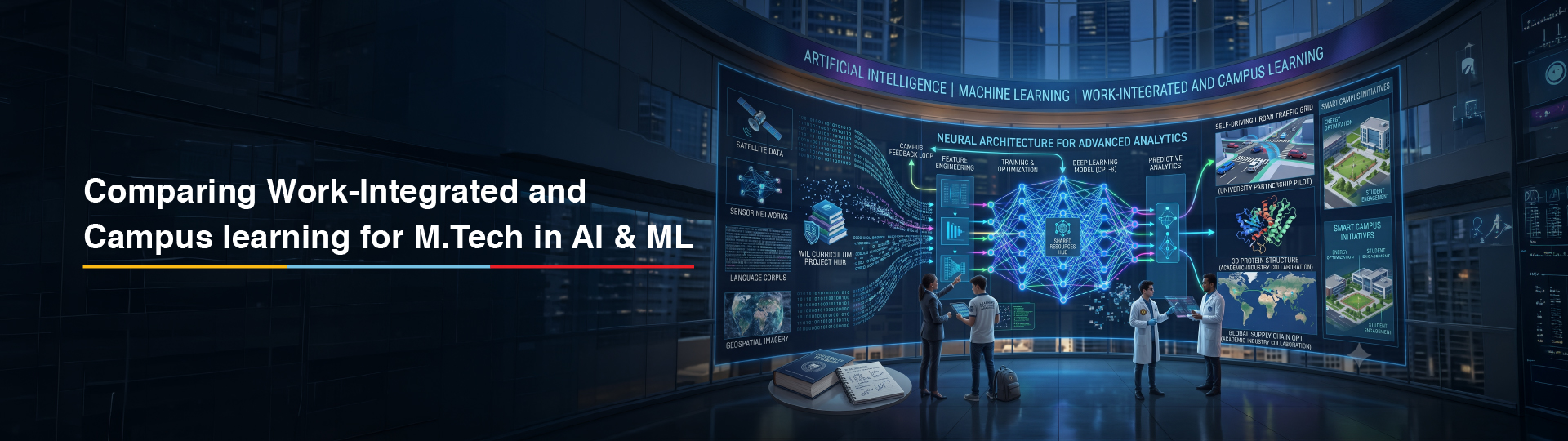

How Should Working Professionals Compare Work-Integrated and Campus M.Tech in AI & ML?
Ask ten engineers why they're pursuing an MTech in artificial intelligence, and nine will give you some version of the same answer. Break into AI/ML or move up faster within it. Ask them whether they should do it without leaving their job or by heading back to campus full-time, and the confidence disappears fast. That hesitation is fair. Two formats claim to lead to the same outcome, and each one has a case for why it's the smarter route.
It isn't the curriculum that settles this. In India, core coursework across reputable institutions is remarkably similar, no matter which format you choose. What actually separates a good decision from a costly one has less to do with the syllabus and more to do with where you already stand in your career, and that's the part almost nobody spells out clearly before you commit.
The Real Cost of a Traditional M.Tech for Working Professionals
Consider what a traditional, on-campus M.Tech actually costs a mid-career professional. There's the tuition, obviously. But set that aside for a moment. A software engineer or data analyst earning between 12 and 20 LPA who takes a two-year career break to pursue a full-time degree is forgoing somewhere between 24 and 40 lakhs in gross income. Add relocation, accommodation, and lost ESOP vesting, and the real cost of a traditional M.Tech can dwarf the fee structure.
This isn't a reason to dismiss the traditional route. It's a reason to think about it clearly.
Work-Integrated M.Tech in AI and ML vs Traditional M.Tech: Curriculum and Format Differences
The curriculum gap between work-integrated and on-campus MTech in AI and ML is narrower than most people assume. Both formats cover machine learning algorithms, supervised and unsupervised learning models, deep learning architectures, neural networks, and applied AI. The difference between machine learning and deep learning, the mechanics of reinforcement learning, and probabilistic models are covered in both.
It's worth being precise about what "work-integrated" actually means here, because it is not just shorthand for online. A generic online degree is built around access: log in from anywhere, whenever it suits you. A work-integrated programme is built around your job specifically. Sessions are scheduled for after office hours or on weekends so the coursework is organised around the working life you already have, rather than running as a separate track you fit in whenever you find time.
Work-integrated programmes run cloud-based labs and remote project environments that replicate what you'd do on campus. In practice, this spans virtual labs (software hosted on the cloud and accessible any time), remote labs where you operate physical lab equipment from a distance for controlled experiments, and simulation and web-based labs covering specific software tools and case studies, so the practical component is a mix of formats depending on what a given topic actually requires, not a single static substitute for a physical lab.
What genuinely differs is the texture of the experience.
On-campus programmes offer in-person lab access to hardware (GPU clusters, robotics labs, sensor equipment) that cloud environments approximate but don't fully replicate. Research mentorship is more organic: you run into your guide in the corridor, you attend lab meetings, you're embedded in a department's intellectual culture. Campus placements are structured and centralised; companies come to you. For someone targeting AI/ML research roles or positions at organisations that recruit exclusively through campus pipelines, the traditional route has a real structural advantage.
Work-Integrated Learning programmes or WILPs, at institutions like BITS Pilani, are built around a different set of assumptions entirely. Classes run in the evenings and on weekends. You don't leave your job. The dissertation co-supervisor is often someone from your own organisation, which means your research can map directly onto problems your team is actually trying to solve. There's something to be said for studying types of machine learning on a Tuesday evening and deploying a model variation at work on Wednesday morning.
None of this runs on an honour system. Enrolment requires employer consent upfront, and the dissertation is supervised jointly by an academic guide and a designated workplace mentor, which keeps the project tied to something the organisation actually needs rather than a simulation of one. That structure is why capstone work out of these programmes tends to look less academic than expected: AI/ML-driven automotive capstones built around an in-house ADAS lab, for instance, where the sensor fusion and computer vision pipelines being studied are the same ones running in a live testing environment, not a synthetic dataset assembled for a grade.
Eligibility Criteria: Work-Integrated M.Tech in AI & ML vs Traditional M.Tech
Here's something that catches people off guard: Work-integrated M.Tech programmes in AI & ML typically require a minimum of two years of professional experience. A fresh graduate cannot simply opt for the work-integrated route because it seems easier. The experience prerequisite isn't bureaucratic gatekeeping. It's structural. The pedagogy assumes you're applying concepts in a live work context; assignments are designed around real organisational problems, and the peer cohort is expected to bring industry perspective into discussions.
Traditional M.Tech programmes, by contrast, are primarily designed for students entering directly from B.Tech. GATE scores are the standard entry mechanism, though several institutions run their own entrance tests for specific programmes.
What to Look for in an Work-Integrated M.Tech in AI & ML
For working professionals in India, not all work-integrated M.Tech programmes are structured equally. The ones worth considering share a few characteristics: live sessions (not just recorded lectures), cloud or remote lab access that mirrors on-campus practical work, a dissertation framework that requires formal employer consent and supervision from a designated workplace mentor alongside the academic guide, and a UGC-recognised degree at the end of it.
BITS Pilani's Work Integrated Learning Programme (WILP) in AI & ML is built around exactly this model. It is one of the longer-standing WILP offerings in the country, with a credit-based structure, remote lab infrastructure, and an academic framework designed specifically for professionals who cannot relocate or take a career break. The degree carries the same formal recognition as a traditional M.Tech for employment, promotion, and further academic progression.
One important clarification worth repeating: a WILP M.Tech is a UGC-recognised degree. Not a diploma. Not a certificate course. The distinction matters when you're using it for a role change, a salary negotiation, or a PhD application.
Artificial Intelligence and Machine Learning Curriculum: What Both Formats Actually Cover
A lot of the content circulating around AI ML courses spends considerable time on definitional questions: artificial intelligence vs machine learning, machine learning vs deep learning, and so on. These distinctions matter for understanding the field conceptually, but they're not the axis on which professionals should be choosing a programme format.
Both a work-integrated and a campus-based M.Tech will cover artificial intelligence and machine learning as a unified discipline. Both will walk through machine learning models from linear regression to transformer architectures. The format question is about your professional circumstances, your career trajectory, and your risk tolerance, not about access to content.
What the Choice Actually Comes Down To
If you're already working in a technical role, earning well, and looking to transition into AI/ML or deepen existing skills, a work-integrated M.Tech makes logical sense. You retain income, you gain a recognised postgraduate qualification, and you can apply your learning in real time. BITS Pilani WILP is a credible, established option with a track record specifically built for working professionals.
If you're earlier in your career, open to a two-year break, and targeting research-heavy roles or employers who recruit through campus placement drives, a traditional M.Tech gives you access to networks and institutional infrastructure.
The programme format doesn't determine the quality of the degree. What it determines is whether the next two years cost you a career pause or accelerate the one you're already building.


