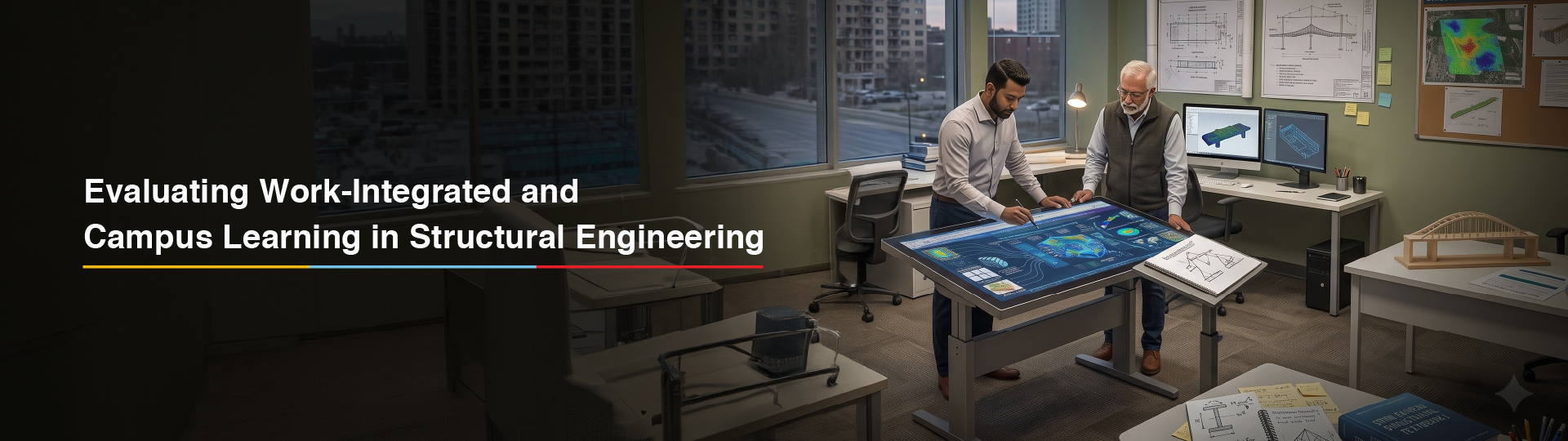

How Should Working Engineers Evaluate Work-Integrated vs Campus M.Tech in Structural Engineering?
Every working structural engineer who starts researching a postgraduate degree runs into the same fork almost immediately. Take the two-year break, move onto a campus, get the full residential experience, and come back to a career that's been on pause for exactly that long. Or stay employed, go work-integrated, and hope the credibility and hands-on exposure hold up without ever stepping away from your desk.
Neither option looks obviously wrong on the surface, and neither camp is short on people insisting theirs is the better route. Let’s check out which route is better for the working professional preparing to pursue a structural M.Tech.
What Is M.Tech Structural Engineering, and Why Does the Format Actually Matter?
At the postgraduate level, structural engineering stops being about applying known methods and starts being about understanding why those methods work, where they break down, and what to do when standard approaches are insufficient. With Structural mechanics, advanced structural analysis, bridge engineering, seismic behaviour, and finite element methods, the curriculum is dense. The depth is real regardless of which format delivers it.
But format shapes far more than convenience. It affects cost, career continuity, lab access, and how you actually use what you learn. Two engineers completing the same M Tech structural engineering, one on campus, one work-integrated, will finish with the same credential. The experience getting there, and what surrounds it, will be meaningfully different.
Traditional On-Campus M.Tech in Structural Engineering: Who It's Actually Built For
Most courses on M Tech Structural Engineering are full-time residential set up with a duration of two years. That is the honest summary.
On-campus programmes are designed around immersion. You are physically present for lectures, lab sessions, and faculty interaction. Computer-aided structural analysis tools are taught alongside the hardware and testing environments that give them context. Bridge engineering modules include visits, case studies, and sometimes direct involvement in ongoing research. The learning environment is dense in a way that a work-integrated format simply cannot replicate.
For engineers who want to go deep into research, an on-campus M.Tech is still the superior route. Labs, faculty-led projects, thesis work, and access to institutional resources matter more than the mode of delivery in a research context. Campus placements are another real advantage: companies recruit directly, infrastructure exists, and the pipeline is structured rather than self-driven.
The trade-off is blunt, though. Relocation. Lost income for two years. A gap in the professional timeline. For someone early in their career with no dependents and a genuine appetite for research, it is a trade-off worth making. For most working engineers, it is not.
Work-Integrated Masters in Structural Engineering: What's Changed and Why It's Worth Taking Seriously
The reputation of work-integrated degrees in India has shifted considerably. A decade ago, scepticism was warranted. Today, serious institutions run work-integrated M.Tech programmes under the WILP (Work Integrated Learning Programme) framework with UGC recognition, the same curriculum as their on-campus counterparts, and delivery built around working schedules.
Evening and weekend classes. Cloud-based lab environments covering advanced structural analysis and finite element methods. Dissertation projects that engineers can ground in their actual work, often co-supervised by someone from their own organisation. This isn't a loose arrangement: enrolment requires employer consent, and the dissertation is jointly supervised by an academic guide and a designated workplace mentor, which keeps the project accountable to something the employer actually needs.
What a work-integrated master's in structural engineering delivers to a working professional that an on-campus programme cannot:
- Continuity: you keep practising, keep earning, keep accumulating the site and project experience that structural engineering roles actually reward
- Immediate application: structural mechanics you study on a Wednesday can inform a design decision by Friday
- Lower total cost, with no accommodation, relocation, or two years of foregone salary factored in
- A UGC-recognised M.Tech degree that carries the same standing as the full-time version from a reputed institution
The honest limitation is labs. Simulation environments cover a great deal, but they cannot fully replace physical testing rigs, load frames, or structural dynamics equipment. For engineers whose career ambitions involve hardware-heavy research, that gap is real. For those moving toward senior design, structural consulting, or project leadership, it rarely matters in practice.
Work-integrated vs Campus M Tech Structural Engineering: Choosing Based on Where You Are
The decision is not really about which format is better in the abstract. It is about what your situation actually requires.
A work-integrated master's in structural engineering makes sense if:
- You are already in structural or civil engineering practice and cannot step away
- Your goal is senior technical roles, consulting, or project leadership rather than academic research
- You want the credentials and the curriculum without resetting your career timeline
- Applying learning directly to live projects matters to you
An on-campus M.Tech makes sense if:
- You are early career, mobile, and can commit to two full-time years
- Research, faculty mentorship, and thesis-based work are central to where you want to go
- Physical lab exposure is genuinely necessary for your intended specialisation
- Structured campus placements are a priority
BITS Pilani WILP: M.Tech in Structural Engineering for Working Professionals
BITS Pilani's Work Integrated Learning Programme runs M.Tech degrees specifically designed for practising engineers. The WILP model is straightforward: the degree sits alongside your career rather than displacing it. Curriculum standards match on-campus levels. Labs run on simulation and cloud platforms suited to advanced structural analysis and design work. Projects can be developed with direct relevance to your employer's context.
Eligibility requires a relevant engineering degree, a mathematics background at the 10+2 level, and at least one year of professional experience. No career break required. The degree is UGC-recognised and carries institutional weight.
For structural engineers who want postgraduate credentials without the two-year pause, it is a serious option.
The Honest Takeaway
Choosing between work-integrated and campus M.Tech in structural engineering is not about prestige or effort. Both formats demand real academic work. Both produce recognised credentials from reputed institutions.
What differs is who each format actually works for. If you are already in practice and building a career, a work-integrated M.Tech complements what you have already built. If you are starting out and want the full research environment, on-campus gives you something a work-integrated programme cannot replicate.
Worth noting: the preference among working professionals has been shifting toward work-integrated formats specifically, and not by accident. The hybrid structure means what you study on a Wednesday can be tested against a live project by Friday, instead of sitting separate from your job for two years and being reintroduced to it afterward. That doesn't settle the decision for everyone, but it does say something about where the pendulum is moving.


